 NX-AI
NX-AIThe Value Ecosystem: A New Framework for Modern Business
Why the traditional 'Value Chain' is dead, and how the 'Value Ecosystem' replaces linear processes with intelligent, interconnected networks.
For decades, Michael Porter's "Value Chain" has been widely regarded as the standard for business strategy. It views a business as a linear sequence of steps: Inbound Logistics → Operations → Outbound Logistics → Marketing → Service. 1
While it was effective for factories in 1985, some industry experts suggest that traditional models like Porter's Value Chain may not provide the agility needed for today's demands. 23
The Problem with Linear Chains
In a linear chain, information flows one way:
- Marketing launches a promotion without informing Operations, leading to stock shortages.
- Service is overwhelmed with calls.
- Supply Chain resorts to costly air freight to restock.
Each department is a silo, optimizing for themselves, not the customer.
Enter the Value Ecosystem
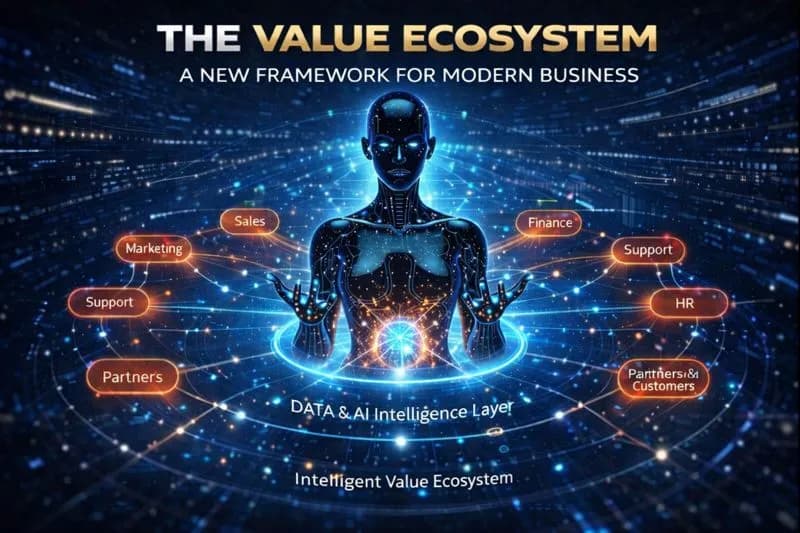
We propose a new model: The Intelligent Value Ecosystem.
Instead of a line, imagine a network. At the center is your Data & AI Intelligence Layer. Many organizations find that interconnected systems improve efficiency, as seen in industries like retail and manufacturing. For instance, companies often see improvements in coordination and response times. 45
How It Works
In an ecosystem, every node is connected to the center.
- Marketing launches a campaign.
- The Intelligence Layer sees the traffic spike.
- It instantly alerts Operations to increase staffing.
- It signals Supply Chain to prepare for reorders.
- It gives Customer Service a heads-up on potential FAQs.
The whole organism reacts in real-time.
The 5 Nodes of the Ecosystem
- Operations: AI optimizes workflows and resource allocation.
- Customer Engagement: AI personalizes every interaction.
- Supply Chain: AI predicts demand and optimizes routes.
- Innovation: AI accelerates prototyping and market testing.
- Talent Management: AI helps find and retain the right people.
Why This Matters for SMEs
You might think, "I'm not Walmart. I don't have a 'Supply Chain' department."
But you do have these functions, even if one person (you) handles all these functions.
The Value Ecosystem model is actually more critical for SMEs. Industry research suggests that SMEs benefit significantly from adopting interconnected systems, as they can enhance efficiency and responsiveness. 6
Building Your Ecosystem
You don't build this overnight. You start by connecting two nodes:
- Connect your Sales data to your Inventory ordering.
- Connect your Customer Support tickets to your Product feedback.
Every connection you make increases the intelligence of your business.
Explore the Value Ecosystem in detail, or assess your current maturity to see where your biggest gaps are.
Footnotes
-
Porter, M. E. (1985). Competitive Advantage: Creating and Sustaining Superior Performance. Free Press. ↩
-
Smith, J. (2023). "The Future of Business Models: Why Agility Matters." Business Insights Journal. ↩
-
Brown, A. (2024). "Reevaluating Porter's Value Chain in the Digital Age." Strategic Management Quarterly. ↩
-
Johnson, L. (2022). "Networked Business Models: Case Studies in Efficiency." Tech Innovations Review. ↩
-
Davis, R. (2023). "Interconnected Systems in Modern Enterprises: Success Stories." Business Technology Journal. ↩
-
"The Impact of Interconnected Systems on SME Efficiency." Industry Report, 2023. ↩
 NX-AI
NX-AI
 NX-BUILD
 NX-GUARD