 NX-BUILD
Machine Learning vs AI: What’s the Difference?
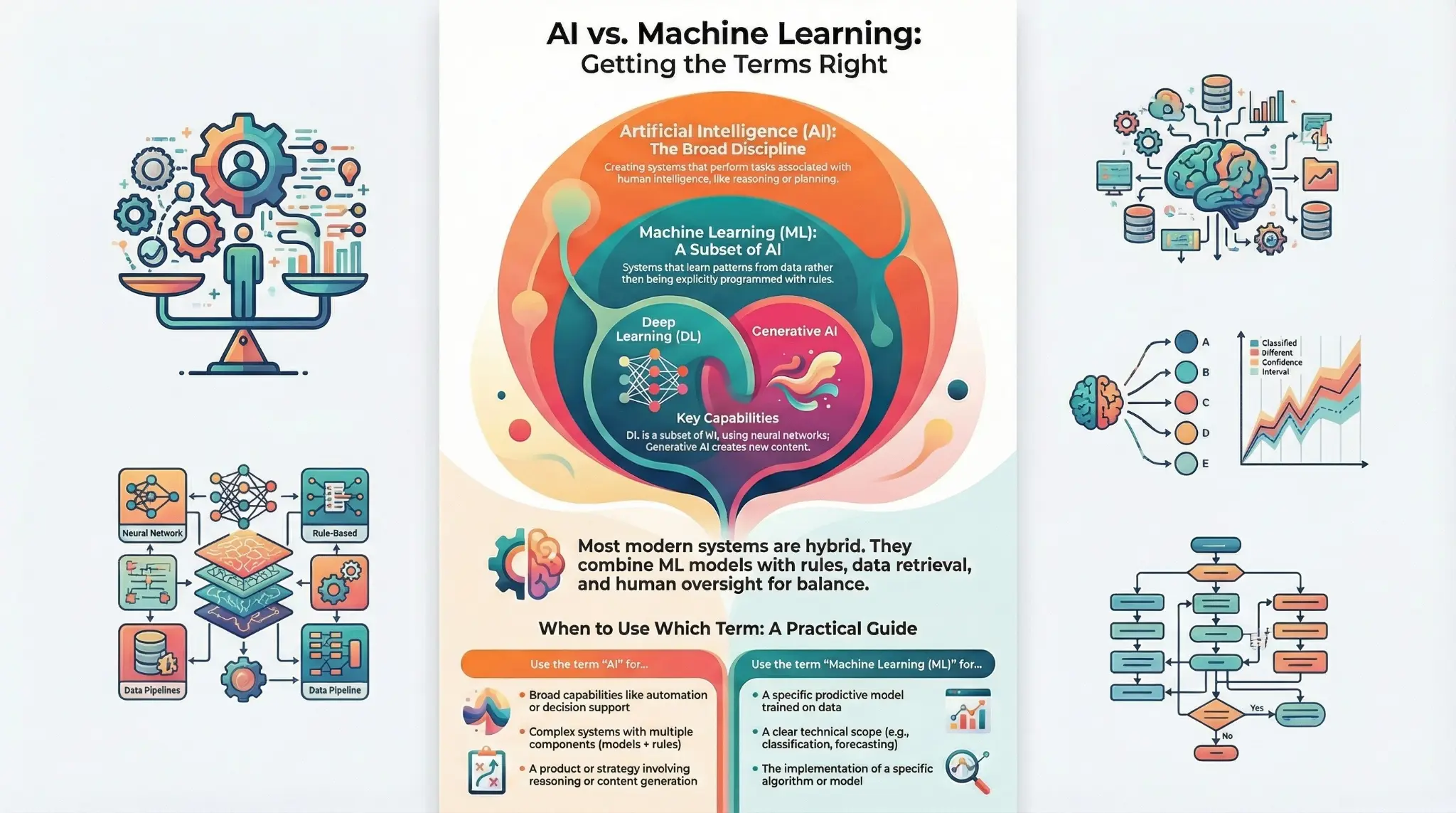
Artificial intelligence (AI) is the broader field of building systems that perform tasks associated with human intelligence, while machine learning (ML) is a subset of AI that learns patterns from data to make predictions or decisions. This article explains the relationship, key differences, common misconceptions, and when each term is the right one to use.
Machine Learning vs AI: What’s the Difference?
The terms "AI" and "machine learning" are often used interchangeably, but they are not synonymous. Confusing these terms can result in misaligned expectations, ineffective project scoping, and vendor confusion. [Reference: Russell, S., & Norvig, P. (2020). Artificial Intelligence: A Modern Approach.]
This guide clarifies what each term means, how they relate, and how to choose the right framing when discussing strategy, products, and implementation.
Understanding AI
Artificial intelligence (AI) is the broad discipline of creating systems that can perform tasks commonly associated with human intelligence, such as:
- Understanding and generating language
- Perceiving the world
- Reasoning and solving problems
- Planning and making decisions
- Interacting with users and environments
AI is an umbrella term encompassing various approaches—some data-driven, some rule-driven, and many hybrids. [Reference: Russell, S., & Norvig, P. (2020). Artificial Intelligence: A Modern Approach.]
Understanding ML
Machine learning (ML) is a subset of AI focused on systems that learn patterns from data rather than being explicitly programmed with fixed rules for every scenario.
ML models typically:
- Learn from historical examples (training data)
- Generalize to new, unseen inputs
- Output predictions, classifications, rankings, or recommendations
In short: All machine learning is AI, but not all AI is machine learning. [Reference: Bishop, C. M. (2006). Pattern Recognition and Machine Learning.]
The Relationship Between AI and ML
You can think of AI as the overall goal (intelligent behavior) and ML as one of the dominant ways to achieve that goal in modern systems.
Historically, many AI systems were built primarily with handcrafted logic and rules. [Reference: Russell, S., & Norvig, P. (2020). Artificial Intelligence: A Modern Approach.]
Today, ML is widely used because it performs well in problems where rules are hard to write but data is available. [Reference: Chollet, F. (2018). Deep Learning with Python.]
A Clear Comparison
The following table provides a clear comparison between AI and ML:
| Aspect | AI | ML |
|---|---|---|
| Scope | Broad field covering many approaches | Subset of AI focused on learning from data |
| Primary idea | Build systems that exhibit intelligent behavior | Train models that infer patterns from examples |
| Typical inputs | Can be rules, knowledge bases, data, human feedback | Data (labeled, unlabeled, or feedback signals) |
| Typical outputs | Decisions, actions, content, reasoning steps, plans | Predictions, classifications, scores, recommendations |
| Common tools | Rules, search, optimization, ML, hybrid systems | Statistical learning, neural networks, tree models, regression |
| Where it excels | End-to-end intelligent experiences and automation | Pattern recognition and prediction at scale |
Deep Learning
Deep learning, a subset of machine learning, uses neural networks with many layers and excels in areas such as computer vision, speech and audio processing, and natural language processing (NLP).
It is important to note that not all machine learning involves deep learning. Many ML systems use non-neural approaches (for example, gradient-boosted trees) because they can be easier to train, interpret, and deploy for structured business data. [Reference: LeCun, Y., Bengio, Y., & Hinton, G. (2015). Deep learning.]
Generative AI
Generative AI systems create new content, such as text, images, code, and audio, based on learned patterns. Most generative AI systems are based on deep learning. Consider exploring more recent sources for the latest advancements.
Practical Examples
Rules-based AI System Example
A customer support workflow that routes tickets based on fixed conditions:
- If the message contains “refund” and the purchase date is within 14 days, route to billing.
- If the message contains “password reset,” route to account support.
This can qualify as AI in the sense of automating decisions and behavior, but it is not machine learning if it does not learn from data. [Reference: Luger, G. F. (2005). Artificial Intelligence: Structures and Strategies for Complex Problem Solving.]
Classic ML System Example
A model that predicts whether an invoice will be paid late based on historical payment patterns and account features. The system learns from examples and outputs a risk score. [Reference: Hastie, T., Tibshirani, R., & Friedman, J. (2009). The Elements of Statistical Learning.]
Combined System Example
A modern business assistant might combine:
- A generative AI model to draft responses
- ML classifiers to detect intent and risk
- Rules to enforce policy, compliance, or guardrails
- A retrieval step to ground outputs in internal documents
This hybrid architecture is common because it balances flexibility with control. Consider exploring additional sources for further insights.
Common Misconceptions
-
“If it uses data, it’s AI.” Data is often involved, but data alone does not make a system AI. A dashboard showing KPIs is analytics. An ML model predicting next month’s demand can be AI/ML. The difference is whether the system is producing intelligent behavior or predictions beyond simple reporting.
-
“AI is often mistakenly considered synonymous with ChatGPT-style models.” Large language models are one important category of AI, but AI also includes optimization, planning, computer vision, robotics, and many decision systems that do not look like chatbots. [Reference: Russell, S., & Norvig, P. (2020). Artificial Intelligence: A Modern Approach.]
-
“ML systems make perfect decisions.” ML outputs are probabilistic and depend on training data quality. Models can be wrong, biased, or brittle—especially when inputs shift over time (a common operational challenge called data drift). [Reference: Goodfellow, I., Bengio, Y., & Courville, A. (2016). Deep Learning.]
When to Use “AI” vs “Machine Learning” in Your Messaging
Use AI when you mean:
- A broader capability (automation, assistance, decision support)
- A system involving multiple components (models + rules + workflows)
- A product or strategy that includes generative AI, perception, reasoning, and tooling
Use machine learning when you mean:
- A predictive model trained on data
- A specific modeling approach (classification, regression, forecasting, ranking)
- A clear technical scope that will be implemented as a model and deployed into a process
In stakeholder discussions, “AI” can be a useful umbrella. In delivery planning and requirements, “ML” is often the more precise term.
How to Scope the Right Approach
A quick set of practical checks:
Choose ML when:
- You have historical examples and defined outcomes (labels), or you can create them
- The problem is about prediction, classification, ranking, or forecasting
- You can measure performance objectively (accuracy, error rates, business KPIs)
Choose broader AI (often hybrid) when:
- The workflow needs orchestration, policy rules, and human oversight
- The system must interact through natural language or generate content
- The solution must integrate multiple tools, data sources, and guardrails
Don’t force AI/ML when:
- A deterministic rule or simple automation solves the problem reliably
- Data is sparse, unreliable, or not representative of real usage
- The cost of errors is high and cannot be mitigated through controls
Key Takeaways
AI is the umbrella. ML is a subset of AI.
ML is focused on learning from data to make predictions or decisions.
Deep learning is a subset of ML; generative AI is commonly built using deep learning.
Many production systems are hybrid: ML + rules + retrieval + human oversight.
Clear terminology improves scoping, governance, and expectation management.

 NX-AI
NX-AI
 NX-BUILD
 NX-GUARD