 NX-BUILD
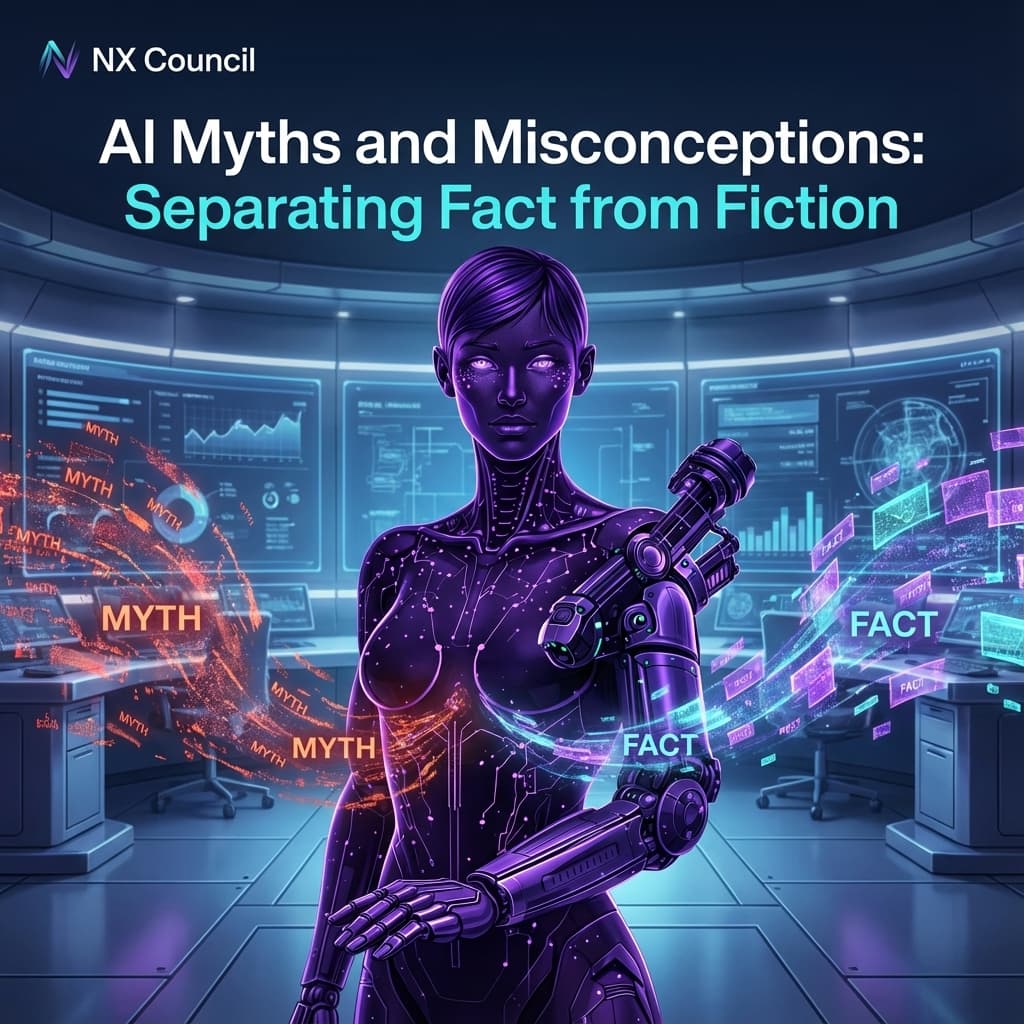
AI Myths and Misconceptions: Separating Fact from Fiction
Artificial intelligence is often misunderstood, leading to unrealistic expectations and misplaced concerns. This article examines common AI myths, explains why they persist, and clarifies what AI systems can and cannot do today.
AI Myths and Misconceptions: Separating Fact from Fiction
Artificial intelligence is discussed more widely than ever before, yet much of that discussion is shaped by misunderstandings. Popular media, marketing language, and science fiction often blur the line between what AI can realistically do today and what remains theoretical or speculative.
This article addresses some of the most common myths about AI and replaces them with grounded, practical explanations.
Myth 1: AI Thinks and Understands Like Humans
AI systems do not possess consciousness, self-awareness, or understanding in the human sense. Modern AI operates by identifying patterns in data and producing outputs based on statistical relationships.
While AI can generate language that appears thoughtful or reasoned, this behavior reflects learned patterns, not comprehension or intent. The appearance of intelligence should not be confused with human cognition.
Myth 2: AI Is a Single Technology
AI is not one technology or system. It is a broad field that includes many approaches, such as:
Rule-based systems
Machine learning models
Deep learning architectures
Optimization and search methods
Hybrid systems combining multiple techniques
When people refer to “AI,” they are often describing a specific application rather than the field as a whole.
Myth 3: AI Systems Are Always Objective
AI outputs are shaped by the data and assumptions used to build them. If training data reflects biases, gaps, or historical inequities, AI systems can reproduce or amplify those patterns.
AI does not independently evaluate fairness or ethics. Addressing bias requires deliberate design choices, testing, and governance.
Myth 4: AI Can Replace Human Judgment
AI is effective at supporting decisions, especially in data-rich environments. However, it does not replace human accountability.
Many real-world decisions involve context, values, and trade-offs that cannot be fully captured in data. In practice, AI systems are most effective when used to augment human judgment rather than replace it.
Myth 5: AI Always Gets Better on Its Own
AI systems do not improve automatically after deployment unless they are explicitly designed and managed to do so. Performance can degrade over time due to changes in data, user behavior, or external conditions.
Ongoing monitoring, evaluation, and maintenance are required to ensure reliable outcomes.
Myth 6: Generative AI Always Produces Accurate Information
Generative AI systems are designed to produce plausible outputs, not guaranteed facts. They can generate responses that sound confident but are incorrect or unsupported.
For this reason, generative AI is often combined with validation mechanisms, trusted data sources, and human review in professional settings.
Myth 7: AI Is Either Perfect or Dangerous
AI is neither infallible nor inherently harmful. Like other technologies, its impact depends on how it is designed, deployed, and governed.
Risks typically arise from poor implementation, lack of oversight, or misuse—not from the technology itself.
Myth 8: AI Adoption Is Mainly a Technical Problem
While AI relies on technical components, successful adoption is largely an organizational challenge. Common non-technical factors include:
Clear problem definition
Data quality and access
Change management
Legal and compliance considerations
Skills and training
Ignoring these factors often leads to disappointing outcomes.
Why These Myths Persist
Several factors contribute to ongoing misconceptions:
Oversimplified media narratives
Marketing claims that overstate capabilities
Rapid product releases without sufficient context
Confusion between research demonstrations and production systems
Addressing these myths requires clearer communication and realistic expectations.
A More Accurate Way to Think About AI
A practical perspective on AI recognizes that:
AI systems are tools, not independent agents with intent
Capabilities vary widely by use case and design
Limitations are inherent and must be managed
Value comes from integration into real workflows
This framing supports more effective and responsible use.
Key Takeaways
AI does not think, understand, or reason like a human.
The term “AI” covers a wide range of technologies and approaches.
Outputs reflect training data and design choices.
AI augments human decision-making rather than replacing it.
Clear expectations are critical for successful adoption.
 NX-AI
NX-AI
 NX-BUILD
 NX-GUARD