 NX-BUILD
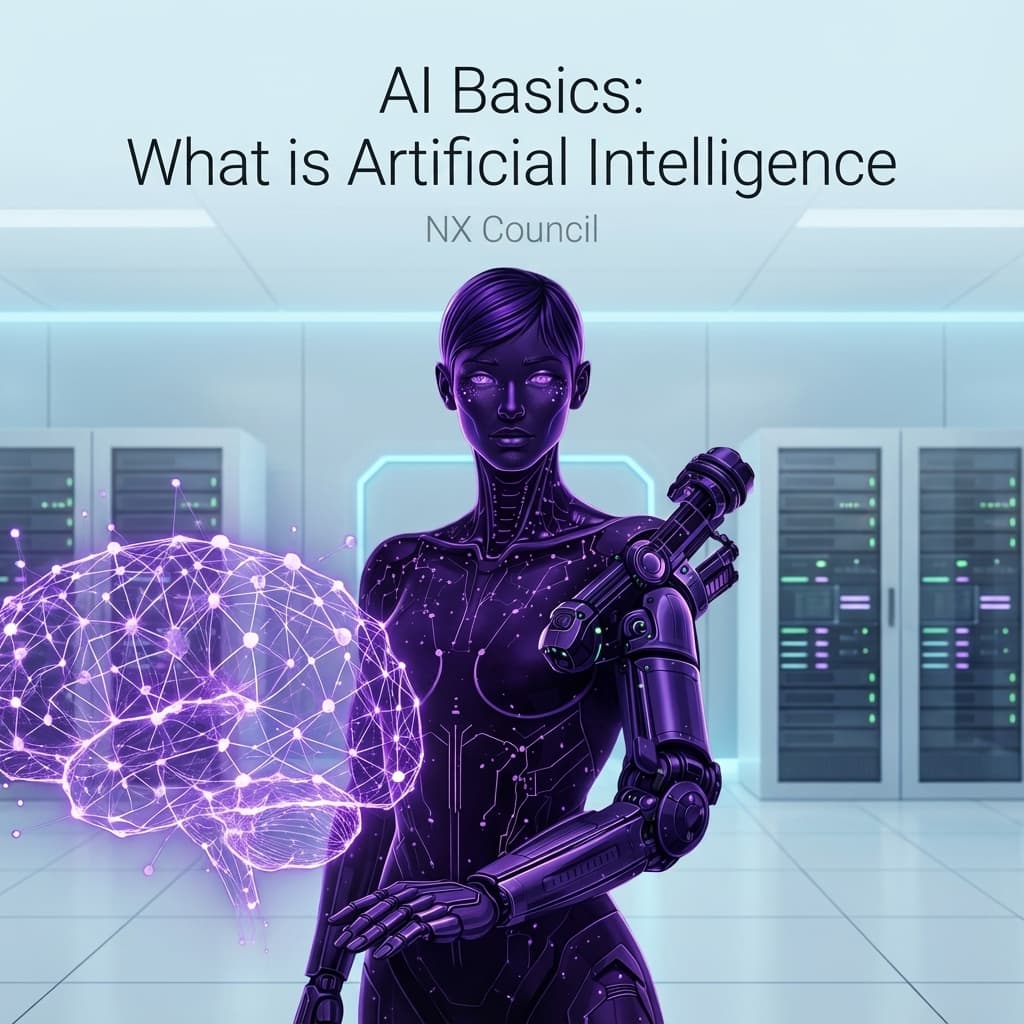
AI Basics - What is Artificial Intelligence
A clear, accurate introduction to artificial intelligence, explaining what AI is, how it works, key types, real-world uses, and common misconceptions.
AI Basics – What Is Artificial Intelligence?
Artificial Intelligence (AI) is one of the most influential technologies shaping modern business, science, and everyday life. Despite its widespread use, the term is often misunderstood, overused, or confused with science fiction. This article provides a clear, factual explanation of what artificial intelligence is, how it works, and what it can—and cannot—do today.
What Is Artificial Intelligence?
Artificial Intelligence refers to computer systems designed to perform tasks that normally require human intelligence. These tasks include learning from data, recognizing patterns, understanding language, making decisions, and solving problems.
At its core, AI is not a single technology. It is a broad field that combines computer science, mathematics, statistics, and domain expertise to build systems that can act intelligently within defined boundaries.
Key point: Modern AI systems do not possess consciousness, emotions, or self-awareness. They operate by processing data according to models and algorithms created and trained by humans.
How Artificial Intelligence Works
Most AI systems rely on three foundational components:
- Data
- Algorithms and Models
- Computing Power
Machine Learning Explained
A large subset of AI is machine learning (ML). Instead of being explicitly programmed with rules, ML systems learn patterns from data.
Common approaches include supervised learning, unsupervised learning, and reinforcement learning.
Types of Artificial Intelligence
Narrow (Weak) AI
The only form of AI that exists today. Designed for specific tasks within limited domains.
General (Strong) AI
A hypothetical concept describing human-level intelligence across domains. It does not currently exist.
Artificial Superintelligence
A theoretical idea where AI surpasses human intelligence. This remains speculative.
Real-World Applications of AI
AI is already embedded in many systems across healthcare, finance, retail, manufacturing, software development, and marketing, primarily as a decision-support tool.
What Artificial Intelligence Is Not
AI does not think, feel, or understand context like humans. It is not autonomous by default and is not free from bias.
Benefits and Limitations
Benefits
- Scales data analysis
- Improves consistency
- Enhances decision-making
Limitations
- Data dependency
- Limited adaptability
- Requires governance and oversight
Why AI Literacy Matters
Understanding AI fundamentals helps individuals and organizations make informed decisions, manage risk, and set realistic expectations.
Conclusion
Artificial intelligence is a powerful but bounded toolset. Its value depends on correct application, governance, and understanding. Clear AI literacy is essential for responsible and effective use.

 NX-AI
NX-AI
 NX-BUILD
 NX-GUARD